The Personality Test Standing Between You and Your Next Job — What the SHL OPQ Is and Why UK Employers Rely on It
Whether you’re pursuing a role at a media agency, a major brand, or a large employer, there’s a good chance a psychometric assessment is part of the process. The SHL OPQ — developed in the UK and used by some of the country’s biggest recruiters — is the one most candidates encounter without ever being told what it actually measures.
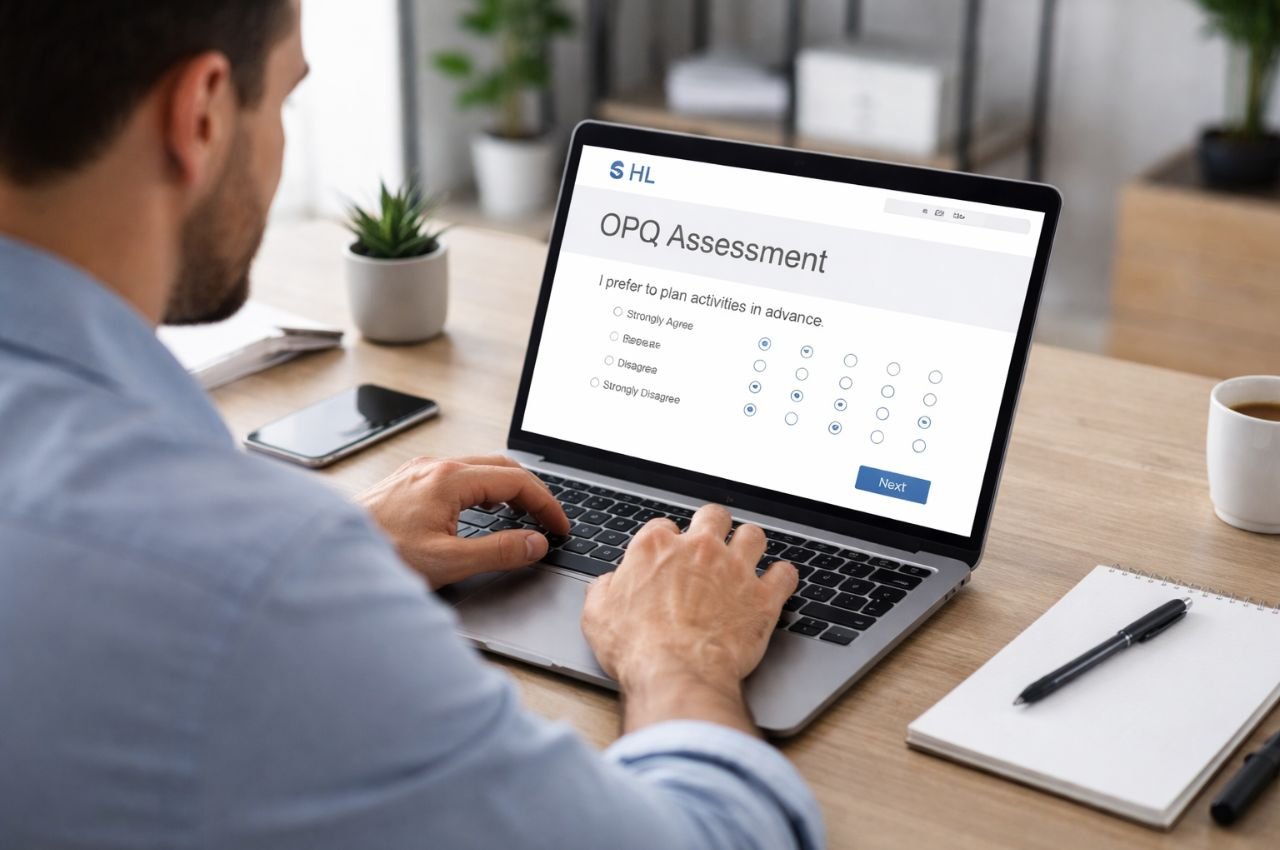
You spend weeks polishing your portfolio, getting your CV right, crafting a cover letter that sounds like you wrote it yourself rather than anyone else. You make it past the first filter. Then the invitation arrives: please complete this online personality questionnaire before your interview. No time limit. No instructions about what they’re actually looking for. Just 104 statements and a request to rank how much each one sounds like you.
This is the SHL OPQ — the Occupational Personality Questionnaire — and it sits in the hiring process of a remarkable proportion of UK employers. Banks, retailers, consultancies, technology companies, media organisations, and public sector bodies all use some version of it. Created by Saville & Holdsworth Ltd in the UK, it has been part of British recruitment since 1984 and is now administered in 37 languages worldwide.
What the OPQ Actually Measures
According to SHL’s official product page, the OPQ measures 32 personality dimensions grouped into three broad areas: how you relate to people, how you approach thinking and problem-solving, and how you manage your emotions under pressure. The most widely used version is the OPQ32r, which contains 104 questions in a forced-choice format. Each question presents three statements and asks you to identify the one that is most like you and the one that is least like you. All three statements are designed to sound reasonable. That is the point.
The forced-choice design is what separates the OPQ from simpler personality tests. You cannot hedge by rating everything at a medium score. Every question forces a trade-off between equally attractive options — revealing your genuine working preferences rather than the version of yourself you think an employer wants to see. It is also harder to fake consistently across 104 questions than most people expect.
Why Employers Use It — Especially in Creative and Digital Roles
For roles that require strong interpersonal skills, client management, creativity, or working under sustained pressure — characteristics of most creative, marketing, and digital roles — the OPQ gives employers a structured, standardised way to evaluate candidates beyond what a CV or even an interview can reveal. With the SHL database now containing benchmark data from over 86 million candidates, employers can compare a candidate’s profile against the typical range for similar professionals.
“Independent creators and freelancers increasingly apply to in-house roles at brands and agencies that use the OPQ as standard. Going in without understanding the format is like showing up to a portfolio review without preparing your work — avoidable and costly.”
For candidates who have never encountered the OPQ before, the format can feel disorientating — not because the questions are hard, but because the logic behind them is unfamiliar. Working through a SHL OPQ practice test before sitting the real assessment gives you a working understanding of how the forced-choice format operates and what the underlying traits are that each statement is measuring. That familiarity makes a real difference in how confidently and consistently you answer under the mild pressure of a live assessment.
What Happens With Your Results
After you complete the OPQ, your responses are scored and compared against a relevant normative group — graduates, professionals, or managers, depending on the role level. The employer receives a profile report that maps your personality preferences to the competencies required for the job. This may be used to guide structured interview questions, inform a final hiring decision, or feed into onboarding and development planning if you are offered the role.
Importantly, the OPQ does not produce a simple pass or fail. It produces a profile — and a profile can be a strong fit for one type of role and a weaker fit for another. Some employers will use your results to design interview questions that probe areas of potential risk for the specific position. Knowing this is useful: the OPQ is not the end of the assessment, it is the beginning of a more targeted conversation.
What to Remember Before You Sit It
The OPQ is untimed — most candidates complete it in 20 to 25 minutes — and there is no right or wrong answer in the traditional sense. The most important thing is consistency. Inconsistent profiles, where your responses contradict each other across related traits, are flagged in the scoring system and can undermine the reliability of your results. Answer based on how you genuinely behave at work, not how you think the role requires you to behave. The tool is sophisticated enough to detect the difference.